Tutorials
This tutorial will show you how to implement Grover’s Algorithm on IBMs Quantum Computers in Python with Qiskit

In this tutorial you will see how a specific type of error called a phase flip error can be corrected using a quantum circuit known as the phase flip code.

This tutorial will introduce the user to the CNOT gate and how to implement it on IBMs quantum computers
The CNOT gate is a mulit-qubit gate that consists of two qubits. The first qubit is known as the control qubit and the second is known as the target qubit. If the control qubit is |1〉then it will flip the targets qubit state from |0〉to |1〉or vice versa.


In this article we will explore the process of Test Driven Development (TDD) and how you can use it to create reliable and dependable software.
Test Driven Development is a development process whereby feature specifications are implemented using unit testing before the software is fully developed. This is in contrast to a development first lifecycle where software is developed first and then the functionality tested using unit tests.

In this article we will explore the five SOLID design principles and how you can use them to make your code more robust and maintainable.
Solid is a set of five design principles devised by Robert C. Martin in his 2000 paper Design Principles and Design Patterns. In the paper Martin outlines the symptoms and causes of software rot and how these can be remedied with five object oriented class design principles.
Note however that in his paper these principles did not use the SOLID acronym. This term was keyed later in 2004 by Michael Feathers.
In this tutorial we will see how to construct an integer comparator in Qiskit for IBM quantum computers.
An integer comparator is a circuit that compares two integers. In Qiskit the integer comparator circuit relies on two’s complement implementation of binary subtraction.

In this tutorial we will create a web application that allows users to solve logical expressions using Grover’s search on IBM’s quantum computers. This web application will consist of a backend and frontend.
In this tutorial we will see how to obtain the unitary matrix of any quantum circuit in Qiskit.
In quantum computing unitary matrices are very important as they describe how quantum logic gates and circuits affect qubit states. However with large quantum circuits it can be difficult to derive the unitary matrix by hand.
However Qiskit thankfully has a function for obtaining unitary matrices for a circuit called result.get_unitary(experiment, decimals)

Proof of Concept is a new exciting tutorial series that will show you how to create quantum applications step by step. In this tutorial we will create a web application that allows users to factor numbers using IBM’s quantum devices. This web application will consist of a backend and frontend.


In this tutorial we will explore the effects of T1 relaxation on IBM quantum computers in Qiskit.
What is T1 relaxation time?
Current superconducting qubits are very susceptible to decoherence due to its external environment. One example of decoherence is thermal relaxation.
Also known as T1 relaxation time this is where a qubits state to decays from 1 to 0 within a certain amount of time.

In this tutorial we will explore the Swap test and how to implement it in Qiskit on IBM quantum computers. The Swap test is a procedure for testing how alike two quantum states are.


In this tutorial we will explore how to do multiplication using the QFT Multiplier circuit on IBM quantum computers in Qiskit.

In this tutorial we will explore Rabi oscillations and how to model them on IBM quantum computers with Qiskit.
A Rabi oscillation is where a two level quantum system constantly oscillates between it’s ground state and an excited due to a driving field. For example when under exposure from a laser an atom will emit and absorb photons at a steady pace.

In this tutorial we will explore how to solve k-SAT problems using Grovers Search on IBM’s Quantum computers in Qiskit. The k-SAT problem is a Boolean satisfiable problem with k literals. Given a Boolean formula consisting of a number of clauses each with k literals the goal is to find what inputs will satisfy the problem.
In our last tutorial we learned how to evaluate logical expressions using Grover’s search. In this tutorial we will explore how to use Grover’s search to instead evaluate truth tables.

In this tutorial we will learn how to solve logical expressions using Grover’s Search algorithm in Qiskit on IBM’s quantum devices.

In this tutorial we will explore a modified version of the Bucket brigade architecture for QRAM and how to implement them on IBM’s quantum devices.
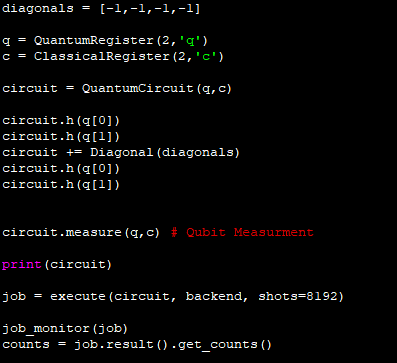
In this tutorial we will explore how to implement the diagonal gate on IBM’s Quantum Computers with Qiskit.
This tutorial is an excerpt from our upcoming textbook Introduction to Quantum Computing with Qiskit.
The diagonal gate a multi-qubit gate that operates on a qubit based upon diagonal entries in it’s matrix. The operation of the diagonal gate can be described using the following matrix:

In this tutorial we will explore how to implement the RY gate on IBM’s Quantum Computers with Qiskit.
This tutorial is an excerpt from our upcoming textbook Introduction to Quantum Computing with Qiskit.
The RY gate is a rotational gate that does a rotation around the Z-axis by a specified amount which is normally denoted by λ.

In this tutorial we will explore the MCMT gate and how to implement it on IBM’s Quantum Computers in Qiskit.
The MCMT (Multiple Control Multiple Target) gate is a generalised gate that allows you to add multiple target and control qubits to a range of gate types.

In this tutorial we will explore how to implement the RY gate on IBM’s Quantum Computers with Qiskit.
This tutorial is an excerpt from our upcoming textbook Introduction to Quantum Computing with Qiskit.
The RY gate is a rotational gate that does a rotation around the Y-axis by a specified amount which is normally denoted by θ.
This tutorial will show you how to implement Grover’s Algorithm on IBMs Quantum Computers in Python with Qiskit
In this tutorial you will see how a specific type of error called a phase flip error can be corrected using a quantum circuit known as the phase flip code.
This tutorial will introduce the user to the CNOT gate and how to implement it on IBMs quantum computers
The CNOT gate is a mulit-qubit gate that consists of two qubits. The first qubit is known as the control qubit and the second is known as the target qubit. If the control qubit is |1〉then it will flip the targets qubit state from |0〉to |1〉or vice versa.


In this tutorial we will explore the Quantum Fourier transform and how to implement it in Qiskit.
In quantum computing the Quantum Fourier Transform (QFT) is a circuit that transforms the state of the qubit from the computational basis to the Fourier basis.
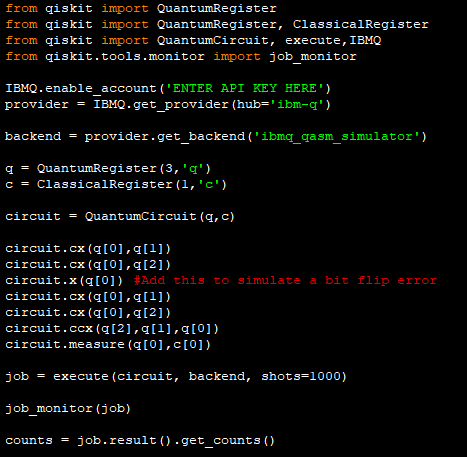
Qubits are very fragile and are prone to errors due to decoherence and other quantum noise. However using quantum error correction qubit errors can be corrected.
In this tutorial you will see how a specific type of error called a bit flip error can be corrected using a quantum circuit known as the bit flip code.


In this tutorial we will explore the Z gate including what it does and how to implement it in Python and Qiskit.

In this tutorial we will explore how to implement a Quantum Support Vector Machine (QSVM) AI machine learning method on IBM’s Quantum computers using Qiskit.


This tutorial will show you how to start programming for D-Waves systems by implementing logic gates on the processor as a simple example.


In this tutorial we will explore Bell states and how to implement them IBM Quantum Computers with Qiskit. Bell states are the four states that can be created when two qubits are maximally entangled.